Kenya’s electricity power gap, though not given the attention it deserves, affects taxpayer taxable profits, tax compliance, and the amount of tax the government collects. As a taxpayer in this country whose business depends heavily on power, you must have experienced the now-famous Kenya power blackouts.
Probably you have been thinking about the source of the blackouts and what you can do about it. The sources of the blackouts are from the supply and demand sides of electricity consumption.

In this article, we analyze the data on Kenya’s electricity production shortfall over the past five years (2019-2023) and examine the underlying reasons. We will also explain how the demand or consumption causes the power blackouts.
This will enable you to decide the actions that you will take to improve your power supply.
Kenya’s Electricity Production and Shortfall
In this article, we examine 5 years of data from 2019 to 2024. This was the most current available data. In the following table, the data is on the peak electricity demand versus the available capacity, the shortfall, and the key reasons.
Table 1: Kenya’s Electricity Production and Shortfall (MW) (2019 – 2023)
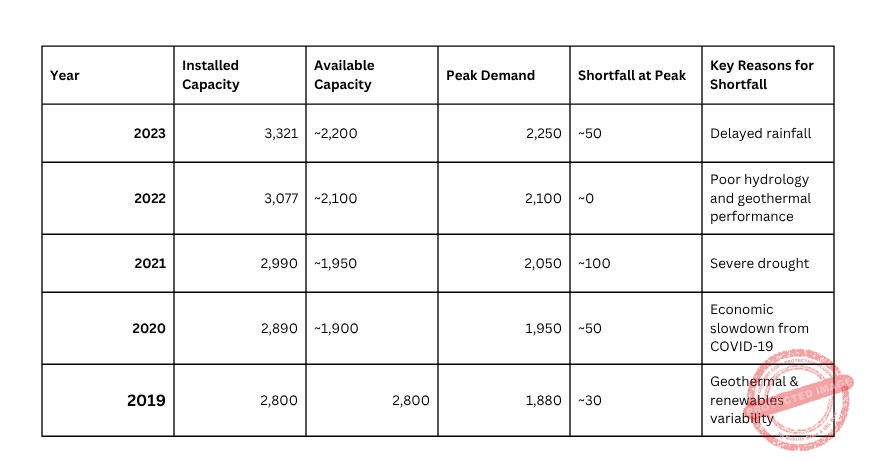
Sources: Kenya National Bureau of Statistics (KNBS), the Energy and Petroleum Regulatory Authority (EPRA), and Kenya Power’s annual reports.
Key Insights from the Data
1. The Installed vs. Available Gap
There is a persistent significant difference between installed capacity (the total power capacity of all power plants) and Available Capacity (the actual power that can be dispatched). What are some of the reasons?
a. Maintenance Issues
Power plants are machines that require scheduled or emergency shutdowns for maintenance or to be taken offline for scheduled or emergency repairs. This will affect the amount of power produced.
b. Weather Dependence
Hydropower plants in this country rely on rainfall. During droughts, when the amount of water flowing into the dams is affected, the power output is also affected. This can fall drastically. A case in point is what happened in 2021.
c. Intermittency
The country has also been relying on wind and solar power to boost its energy production. The availability of wind and solar power is not within the control of the government, but rather within the control of nature. Though the two are crucial, they are not always available or predictable.

2. The Demand is Constantly Growing
Peak demand has been steadily rising by roughly 4-5% per year. Population growth, industrialization, and increased connectivity drive this increasing trend. The power grid has not been expanded at the same rate. Hence, it must also constantly expand to keep pace.
3. The Nature of the Shortfall
The power shortfall is not a constant 24/7 power cut. It is primarily experienced during evening peaks. This is when everyone gets home and switches on the power to light the house, use TVs, and other appliances. The shortfall can also occur during periods of drought when hydropower is unavailable.
Many times, this shortfall results in load shedding in many households. Therefore, you might experience load shedding for a few hours in the evening, but have stable power throughout the day.
Reasons for the Electricity Shortfall
There are many reasons for the energy shortfall in the country for the five years under analysis. In the following table, we have detailed the key reason in each year.
Table 2: Reasons for the Electricity Shortfall
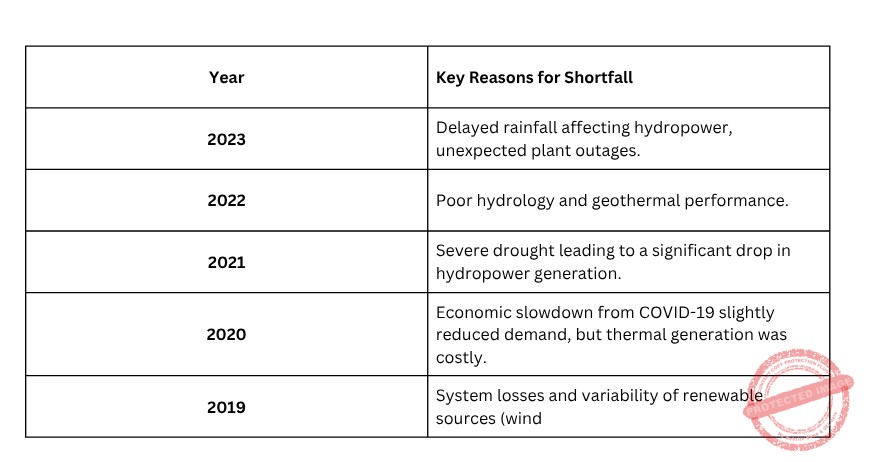
Sources: Kenya National Bureau of Statistics (KNBS), the Energy and Petroleum Regulatory Authority (EPRA), and Kenya Power’s annual reports.
4. The Role of Imported Electricity
Kenya has increasingly relied on power imports from Ethiopia to help bridge this electricity gap, especially during peak times and droughts. This is a strategic move to avoid firing up expensive and polluting emergency thermal generators. With the new GERD dam, the power expense may come down.
What is the Government Doing?
The underproduction of power in the country is detrimental to the country’s economic health and growth. Taxpayers who rely on electricity for their production have to deal with blackouts and expensive power supply. This affects their tax compliance and the tax they pay.
This power shortfall situation cannot be allowed to continue. Currently, the government’s strategy to mitigate this shortfall involves the following:
a. Geothermal Expansion
This involves adding base-load power from geothermal sources in the Olkaria fields, which is not weather-dependent.
b. Transmission Upgrades
This involves improving the power grid to reduce system losses and more effectively distribute power from where it is generated to where it is needed.

c. Regional Power Pooling
EAC countries are increasingly importing power from Ethiopia and other neighbors to access cheaper power during shortages. Kenya has not been left behind.
d. Demand-Side Management
The country is encouraging its citizens to use power efficiently during peak hours. This will reduce the strain on the grid. We have presented data that clearly show the country has a serious energy shortfall. Kenya is working diligently to transition from a developing to a developed global nation.
Final Thoughts
While Kenya has made incredible strides in renewable energy generation, the balance between supply and demand remains a delicate one. That balance is heavily influenced by climate and economic factors. For taxpayers whose businesses rely heavily on electricity, this is a point of concern.
Other Related Articles:
a. Cost of Electricity Power Gaps to Taxpayers – HERE
b. Electricity Power Gaps Drain Revenue – HERE
c. Ethiopia GERD Dam For Kenya – HERE
Read More Articles – HERE
For tax consultancy and investment advisory – HERE